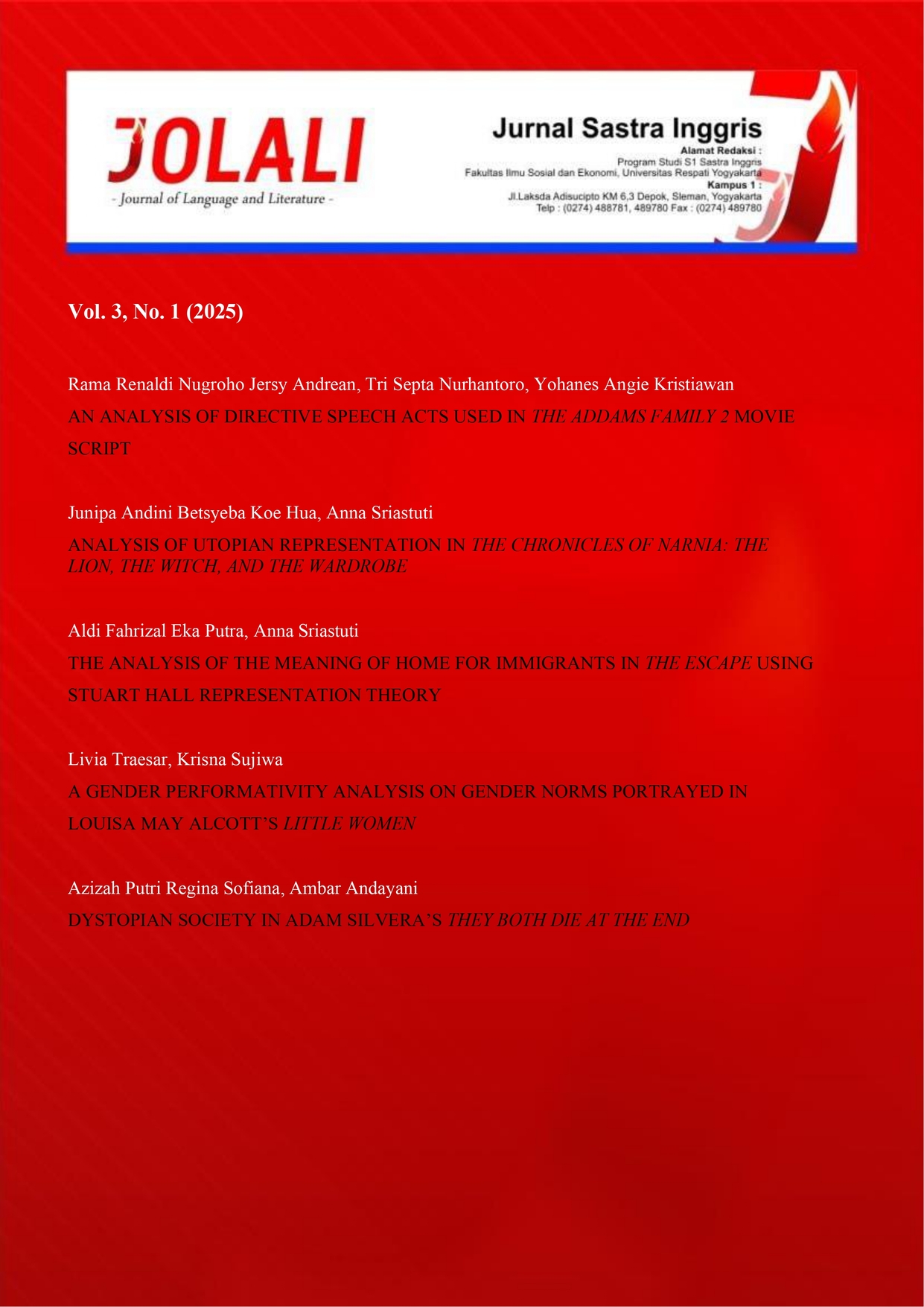
THE ANALYSIS OF THE MEANING OF HOME FOR IMMIGRANTS IN THE ESCAPE USING STUART HALL REPRESENTATION THEORY
DOI:
https://doi.org/10.35842/jolali.v3i1.44Keywords:
escape, home, immigrants, MoslemAbstract
For a lot of people, home is a place that serves the purpose only to gather and take a rest. But, for immigrants, especially one that lives away from their birthplace, home is something that they always miss a lot, since they live far away from their homeland. For Moslem, they have certain events where they are able to go back to their home and it is called Eid Al-Fitr. There is something about the way Samir finds the meaning of home through the journey that he must do to escape from his trauma due to the death of his wife. In order to find the actual meaning of home, Representation Theory by Stuart Hall will be applied in this research by understanding the way Samir see’s home. The result from this research will provide readers about the actual meaning of home, whether home is a place to take a rest or about where someone's heart belongs too.
References
Adichie, C. N. (2013). Americanah. Alfred A. Knopf.
Badan Pengembangan dan Pembinaan Bahasa. (2016). Kamus Besar Bahasa Indonesia. 5th ed., Kementerian Pendidikan dan Kebudayaan.
Bolter, J. (2019). Who is an immigrant? Migration Policy Institute, 1-5.
Kothari, C. R. Research methodology: Methods and techniques. 2nd ed., New Age International Publisher.
Kumar, R. (2011). Research methodology: A step-by-step guide for beginners. 3rd ed., SAGE Publications.
Lahiri, J. (2003). The namesake. Houghton Mifflin.
Relph, E. (1976). Place and placelessness. Pion Limited.
Shahraz, Q. (2009). The escape. Vol. 3, Asiatic.
Sinclair, U. (1906). The jungle. Doubleday, Page & Company.
The Quran. (2000). Translated by Abdullah Yusuf Ali, 16:80. Wordsworth Editions.
Downloads
Published
Issue
Section
License
Copyright (c) 2025 JOLALI: Journal of Language and Literature

This work is licensed under a Creative Commons Attribution-NonCommercial 4.0 International License.
- Authors retain copyright and grant the JOLALI: Journal of Language and Literature right of first publication with the work simultaneously licensed under a CCreative Commons Attribution-NonCommercial 4.0 International License that allows others to share (copy and redistribute the material in any medium or format) and adapt (remix, transform, and build upon the material) the work for any purpose, even commercially with an acknowledgment of the work's authorship and initial publication in JOLALI: Journal of Language and Literature.
- Authors are able to enter into separate, additional contractual arrangements for the non-exclusive distribution of the journal's published version of the work (e.g., post it to an institutional repository or publish it in a book), with an acknowledgment of its initial publication in JOLALI: Journal of Language and Literature.
- Authors are permitted and encouraged to post their work online (e.g., in institutional repositories or on their website) prior to and during the submission process, as it can lead to productive exchanges, as well as earlier and greater citation of published work (See The Effect of Open Access).